

A stave, also known as staff, is a horizontal row of lines on a music page, consisting of five lines and four spaces just like how we have our five fingers and four spaces (gaps) between them. Musical notes are written on each line and space and have varied names depending on placement and clefs (which we will discuss in the following chapters). It represents the pitch and duration of musical notes, providing a visual guide for accurate reading and interpretation, essential for musicians of all levels.
Do you know that music has a secret code? Just like you write letters and numbers on lined paper, music has its special way of writing notes. It’s called the “music stave” or “staff.” In this exciting adventure, we’ll explore the wonderful world of the stave and uncover its mysteries.
The Musical Playground
Imagine your fingers as the stars of a musical playground. Just like you have five fingers and four spaces in between, the music stave also has five lines and four spaces. Each line and space on the stave has a special job, just like each of your fingers.
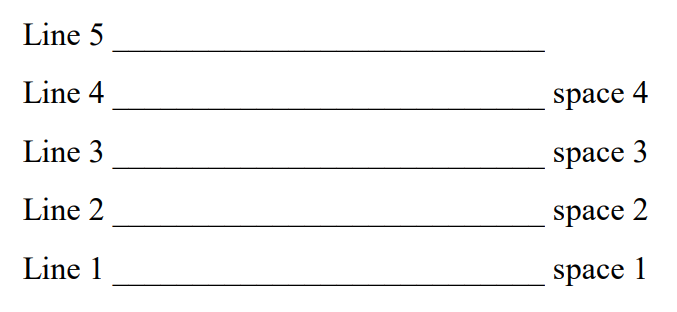
Meet the Stave
- Line 1 (The Bottom Line): Just like your thumb is the closest to the ground, the bottom line is the first line on the stave. It’s like the “home base” for notes.
- Line 2: This is the second line on the stave. Imagine it’s like your pointer finger, ready to point out musical notes.
- Line 3: The third line is like your middle finger, standing tall and proud among the notes.
- Line 4: This line is like your ring finger, and it’s ready to create beautiful music.
- Line 5 (The Top Line): The top line is the fifth and final line on the stave, just like your pinky finger, reaching for the sky.
The Magical Spaces
Now, let’s talk about the spaces between the lines on the stave. They’re like the gaps between your fingers.
- Space 1: The space above the bottom line is like the space between your thumb and pointer finger.
- Space 2: This space is like the gap between your pointer and middle fingers.
- Space 3: The space between your middle and ring fingers is similar to this space on the stave.
- Space 4: Finally, the space above the top line is like the gap between your ring and pinky fingers.
Making Music on the Stave
Now that you’ve met the stave and its lines and spaces, it’s time to make some music! Musicians use the stave to write down musical notes. Each note has its special place on the stave, just like each finger has its place in your hand.
When you see notes on the stave, you can tell which pitch or sound to play, just like you know which finger to use for different tasks.
Remember, the stave is like a musical map, guiding musicians to create beautiful melodies and harmonies. Learning to read the stave is like learning to read a musical treasure map!
Conclusion
The music stave is a fantastic tool that helps musicians read and play music. Just like your fingers work together to do amazing things, the lines and spaces on the stave work together to create wonderful melodies and songs.